"Where there is no vision, the people perish: but he that keepeth the law, happy is he."
-- Proverbs 29:18, King James Bible (KJV)

Thursday, June 25, 2015

U.S. Supreme Court Upholds Congress's Patient Protection and Affordable Care Act (Also Known as "Obamacare") in a 6-3 Vote in an Opinion Written by SCOTUS Chief Justice John G. Roberts and Joined Inter Alia by Justice Anthony Kennedy

It is a great day for America.

The Supreme Court of the United States (SCOTUS) has upheld The Patient Protection and Affordable Care Act ("Obamacare") in a 6-3 vote of the nine Justices. Read the majority opinion and dissent at SCOTUS.

We anticipated both the result and the reasoning of the holding in this case in our previous LawPundit posting of June 21, 2015 in Does Upholding Dewsnup in Caulkett Mean Obamacare Will Be Saved by the U.S. Supreme Court?

The majority opinion was written by Supreme Court Chief Justice John Roberts, joined by Justices Ruth Bader Ginsburg, Stephen Breyer, Sonia Sotomayor and Elena Kagan, and to his great credit now, after dropping the ball on the first SCOTUS Obamacare case, by Justice Anthony Kennedy, who thereby returns to our good graces. When the going gets tough, the tough get going ... and do the right thing. Well done, Justice Kennedy!

Kennedy's shift to the majority from his minority stance in the first Obamacare case is in our opinion a strong signal that Obamacare-opponents are playing a losing game in their attacks on Obamacare.

The "terrible trio" of Justices Antonin Scalia, Clarence Thomas and Samuel A. Alito Jr. dissented, suggesting that they have learned little since the first Supreme Court Obamacare decision, in which they were also in the minority. It would be good if these three Justices would at some time in their careers rise above their personal political prejudices and private intellectual theories about law and the Constitution and be the wise and impartial Justices they should be, but are not, in deciding matters of great importance to the nation.

The U.S. Supreme Court should never overturn major laws as passed by Congress for linguistic hair-splitting reasons, and we say this as co-author of a dictionary, who knows how difficult pinpointing the meanings of words can be in reality, and how little proper attention is paid to linguistic detail in lawmaking.

If the nation ultimately wants it, nothing prohibits Congress from repealing Obamacare, which is unlikely, however, since it has been a success. What Scalia writes in his dissent -- even resorting to calling Obamacare "SCOTUS-care" -- is ridiculous, and unfit for a Supreme Court Justice. Not worthy of that position.

 Indeed, as Roberts observes in the majority opinion concerning "the words":
"The Affordable Care Act contains more than a few examples of inartful drafting.
...
Several features of the Act's passage contributed to that unfortunate reality. Congress wrote key parts of the Act behind closed doors, rather than through "the traditional legislative process." Cannan, A Legislative History of the Affordable Care Act: How Legislative Procedure Shapes Legislative History, 105 L. Lib. J. 131, 163 (2013). And Congress passed much of the Act using a complicated budgetary procedure known as "reconciliation," which limited opportunities for debate and amendment, and bypassed the Senate's normal 60-vote filibuster requirement. Id., at 159-167.  As a result, the Act does not reflect the type of care and deliberation that one might expect of such significant legislation.
Adam Liptak at the New York Times in Supreme Court Allows Nationwide Health Care Subsidies pinpoints the most important issue in the Roberts opinion:
"Chief Justice Roberts wrote that the words must be understood as part of a larger statutory plan. “In this instance,” he wrote, “the context and structure of the act compel us to depart from what would otherwise be the most natural reading of the pertinent statutory phrase.”

“Congress passed the Affordable Care Act to improve health insurance markets, not to destroy them,” he added. “If at all possible, we must interpret the act in a way that is consistent with the former, and avoids the latter.”
That was, as we predicted, the essential and critical core of the case.

We quote Roberts directly from the opinion:
"We have held that Congress "does not alter the fundamental details of a regulatory scheme in vague terms or ancillary provisions." Whitman v. American Trucking Assns., Inc., 531 U. S. 457, 468 (2001).  But in petitioners' view, Congress made the viability of the entire Affordable Care Act turn on the ultimate ancillary provision: a sub-sub-sub section of the Tax Code. We doubt that is what Congress meant to do. Had Congress meant to limit tax credits to State Exchanges, it likely would have done so in the definition of "applicable taxpayer" or in some other prominent manner. It would not have used such a winding path of connect-the-dots provisions about the amount of the credit.5

Petitioners' arguments about the plain meaning of Section 36B are strong.  But while the meaning of the phrase "an Exchange established by the State under [42 U. S. C. §18031]" may seem plain "when viewed in isolation," such a reading turns out to be "untenable in light of [the statute] as a whole." Department of Revenue of Ore. v. ACF Industries, Inc., 510 U. S. 332, 343 (1994).  In this instance, the context and structure of the Act compel us to depart from what would otherwise be the most natural reading of the pertinent statutory phrase.

[LawPundit note: The text of Footnote 5 is omitted in this excerpt.] 
Reliance on context and structure in statutory interpretation is a "subtle business, calling for great wariness lest what professes to be mere rendering becomes creation and attempted interpretation of legislation becomes legislation itself." Palmer v. Massachusetts, 308 U. S. 79, 83 (1939). For the reasons we have given, however, such reliance is appropriate in this case, and leads us to conclude that Section 36B allows tax credits for insurance purchased on any Exchange created under the Act. Those credits are necessary for the Federal Exchanges to function like their State Exchange counterparts, and to avoid the type of calamitous result that Congress plainly meant to avoid.
                                                *   *   *
In a democracy, the power to make the law rests with those chosen by the people. Our role is more confined
—"to say what the law is." Marbury v. Madison, 1 Cranch 137, 177 (1803). That is easier in some cases than in others.  But in every case we must respect the role of the Legislature, and take care not to undo what it has done.  A fair reading of legislation demands a fair understanding of the legislative plan.
Congress passed the Affordable Care Act to improve health insurance markets, not to destroy them.  If at all possible, we must interpret the Act in a way that is consistent with the former, and avoids the latter. Section 36B can fairly be read consistent with what we see as Congress's plan, and that is the reading we adopt."
Exactly. Right on the money. That is good, solid jurisprudence.

Bravo, Justice Roberts and bravo to the majority on the U.S. Supreme Court!

Roberts and the majority of Justices have done their job, which is to interpret laws rationally. The minority trio have -- again -- dropped the ball.

The Mainstream Press

We refer here to other early reports about this event in the mainstream press:

Wall Street Journal, Washington Wire
Supreme Court Upholds Health-Care Subsidies–Live Blog

The Boston Globe - Mark Sherman
Supreme Court rejects challenge to Obama’s health care law

NPR - Krishnadev Calamur
Supreme Court Rules Obamacare Subsidies Are Legal

USA Today - Richard Wolf and Brad Heath
Supreme Court upholds Obamacare subsidies


Saturday, June 20, 2015

La Ciudad Perdida, the Lost City of Colombia, South America, Marks the Stars of Corvus as a Heart, plus a Southern Hemisphere Sky Map Megalith

La Ciudad Perdida, "The Lost City", also known as Teyuna or Buritaca, is located in the Magdalena Department of the Sierra Nevada de Santa Marta, Colombia, South America, and has the GPS coordinates 11°2′16.79″N 73°55′30.69″W. It predates Machu Picchu in Peru by many centuries and has one of the most magnificent ancient megalithic stones we have seen.

The Global Heritage Fund (GHF) in partnership with the Colombian Institute of Anthropology and History are involved with the management, documentation, and conservation of the Teyuna-Ciudad Perdida Archaeological Park.

Archaeology magazine, Volume 57 Number 5, September/October 2004, has an article by Toby Muse titled Lost City, who writes about Ciudad Perdida that the native inhabitants of the region, the Tairona (also written "the Tayronas"), call the center of their extremely remote 15000 square mile area in the Sierra Nevada "Teyuna", "the HEART of the world", even though its first modern discoverers called it a "green hell" for its ever-present mosquitoes, thick impenetrable jungles, and densely covered steep mountains.

Even today tourists can not get to the "Lost City" independently but only as part of organized ca. 4-to-5-day hiking tours, which reportedly cover anywhere from  23 kilometers to 44 kilometers of extremely tough jungle hiking, including river crossings and very steep terrain. Suited only for the very fit!

At Ucros Travel, which also has some marvelous photographs, it is written:
"Lost City Colombia - Ciudad Perdida  was discovered in 1976 by a team of archaeologists from the Colombian Institute of Anthropology led by Gilberto Cadavid Luisa Fernanda Herrera.... Recent (2006) Archaeological investigations at the site indicate that this town was founded around 660 AD and abandoned sometime between 1550 and 1600 AD.... It is known as Teyuna by Indians...."
According to our analysis of the ancient land survey of Native America by astronomy, the Lost City of Santa Marta represented the stars of Corvus seen as a "heart", as evidenced in the large arguably "heart"-sculpted stone at the main location of the site. Perhaps these stones were at some time also viewed as a toad, or frog, as seen in those or neighboring stars by Inca cosmology.

The Ciudad Perdida, Colombia, South America
Corvus Heart Stone


See also http://commons.wikimedia.org/wiki/File:YAEL_PHOTOS_898.jpg, which appears to be a similar stone at a different location in Ciudad Perdida.

Ciudad Perdida also has a fantastic megalithic "sky map stone". See  http://commons.wikimedia.org/wiki/File:YAEL_PHOTOS_819.jpg.

That megalith is currently thought to have been a "local" map of the region, created using a "slashed line" stone marking technique also found in the Pacific Northwest, e.g. in Oregon (name origin via "Virgo", so we allege) and Alaska.

Note that in Inupiaq Eskimo language an inuksuk was "a native Alaskan cairn built to mark pathways". See Behind the Name. On one level that is what the ancient land survey of Native America by astronomy was all about.

The Ciudad Perdida Megalith of Colombia, South America suggests that Ciudad Perdida (marking Corvus as a heart) was the top of the stone and that the megalith was marked as a sky map of stars of the southern hemisphere. See photos of the stone by Stan James and Yael Zwighaft of YAEL-PHOTOS, 2008 at
http://commons.wikimedia.org/wiki/File:YAEL_PHOTOS_819.jpg.

This has to be one of the most spectacular of all the megaliths we have thus far seen, apparently carved in the shape of a human head, with the top of the head as the stars of Centaurus and the chin fairly clear, but with asymmetrical star-mandated positioning.

We see the eyes at Volans and Musca, the cheek at Carina, the nose at Mensa and the mouth at Reticulum, which then makes LMC, the Large Magellanic Cloud the moustache. Obviously, the ancients created these anthropomorphic figures in the stones to mark the stars and to make it easier to remember them, just as we do today with the stellar constellations.


The La Ciudad Perdida, Colombia, South America
Southern Hemisphere Sky Map Megalith
(click the graphic for a larger image)


We found the Colombian and Alaskan megaliths by following an "idealized" diagonal line of land survey by astronomy that runs northwest to Alaska from the Herschel Petroglyphs and southeast from the Herschel Petroglyphs through Cahokia to the Miami Circle and approximately through Ciudad Perdida, and then on to the far east coast of South America. We think that this line could be marked as one of two lines marked at the bottom of the Cahokia Birdman Tablet that are perpendicular to the ca. seven horizontal levels found there, which mark the main horizontal survey levels on land in North America. We will post about how that land survey may have looked in a coming posting.

We emphasize again that the ancients may not have used totally straight lines in doing their astronomical land surveys, but rather line and/or angle approximations that were guided by measurements of the stars, Earth topography, resulting Indian trails and other practical considerations. Nevertheless, such lines are useful for analysis in practice for us in doing the decipherments. Exactly what the ancients did still remains open.

THIS POSTING IS Posting Number 109 of
The Great Mound, Petroglyph and Painted Rock Art Journey of Native America

La Ciudad Perdida, the Lost City of Colombia, South America, Marks the Stars of Corvus as a Heart, plus a Southern Hemisphere Sky Map Megalith

Tuesday, June 16, 2015

The Due Process of Law and the Magna Carta

The Economist explains the massive importance of the Magna Carta to the development of the then revolutionary concept of the due process of law, which significantly curtails the absolute powers of the sovereign and is at the root of the modern concepts of democracy and human rights, such as are in the current world substantially under siege.  See Magna Carta at the Economist

Saturday, May 16, 2015

Cognition of Geographic Information and Human Spatial Orientation and Navigation in an Age of GIS and Virtual Reality: Locomotion Wayfinding and Systems of Reference

One critical area of scientific inquiry that bears directly on our ongoing analysis of ancient rock art, megaliths, mounds, earthworks etc. as land survey markers sited by astronomy is the question of human spatial and geographic orientation in a given environment and the role of systems of reference used for this purpose. Far too little research has been devoted to this topic and it is the kind of thing that research foundations should be sponsoring and funding.

We refer here to fundamental articles in Robert B. McMaster & E.Lynn Usery (eds.), 2004/2005. A Research Agenda for Geographic Information Science, CRC Press, Boca Raton, Florida, 402 p., ISBN-13: 978-0849327285 ISBN-10: 0849327288, eBook ISBN 978-1-4200-3833-0

and especially to Chapter 3 by Daniel R. Montello and Scott Freundschuh on the Cognition of Geographic Information, where they write, inter alia:
"Cognitive research about space and place has focused on several issues:  the responses of sensory systems that pick up spatial information, the development of spatial knowledge from birth to adulthood (ontogenesis) and upon first exposure to a new place (microgenesis), the accuracy and precision of knowledge about distances and directions, spatial language, cognitive structures and processes used during navigation, and perceptual and cognitive issues in cartography, and very recently, GIS. With the advent of new technologies like GIS, new questions about spatial perception and cognition develop, and old questions (both basic and applied) become focused in new ways. 
One of the most basic concepts in this area is that of the cognitive map. Introduced by Tolman (1948) in his work with rat spatial behavior, the cognitive map is a mental representation, or set of representations, of the spatial layout of the environment. According to Downs and Stea (1973), “cognitive mapping is a process composed of a series of psychological transformations by which an individual acquires, stores, recalls, and decodes information about the relative locations and attributes of phenomena in his [or her] everyday spatial environment” (p. 9). The cartographic map thus serves as a metaphor for spatial and environmental knowledge. Other metaphors have been offered as well, from topological schemata to cognitive collage (see Montello & Freundschuh, 1995). GIS and virtual reality provide our latest metaphors for environmental knowledge. 
Cognitive researchers are interested in comparing various sources of geographical knowledge. Montello and Freundschuh (1995) review the characteristics of acquiring knowledge from direct environmental experience, static pictorial representations such as maps (see Thorndyke & Hayes-Roth, 1982), dynamic pictorial representations (movies, animations), and language (see Taylor & Tversky, 1992). Montello and Freundschuh listed eight factors that may play roles in differentiating these sources of geographic information: sensorimotor
systems involved, static vs. dynamic information, sequential vs. simultaneous acquisition, the arbitrariness of symbols, the need for scale translations and their flexibility, viewing perspective, precision of presented information, and the inclusion of detail varying in relevance.
It is commonly thought that spatial knowledge of the environment consists of three types of features: knowledge of discrete landmarks, knowledge of routes that connect landmarks into travel sequences, and configurational or survey knowledge that coordinates and metrically scales routes and landmarks. In fact, inspired by Piagetian theory, it has often been suggested that these features represent a necessary learning sequence (Siegel & White, 1975; for an opposing view, see Montello, 1998). Landmarks in particular are thought to play an important role as anchor-points or reference points for the organization of environmental knowledge (Sadalla, Burroughs, & Staplin, 1980; Couclelis, Golledge, Gale, & Tobler, 1987).

Spatial cognition researchers have studied human navigation and orientation (Golledge, 1999). Navigation is coordinated and goal directed movement through space. It may be understood to consist of both locomotion and wayfinding processes.

Locomotion refers to perceptual-motor coordination to the local surrounds, and includes activities such as moving towards visible targets and avoiding obstacles.
Wayfinding refers to cognitive coordination to the distant environment, beyond direct sensorimotor access, and includes activities such as trip planning and route choice. Humans navigate and stay oriented both by recognizing landmarks (piloting) and by updating their sense of location via dead reckoning processes
(Gallistel, 1990; Loomis, Klatzky, Golledge, & Philbeck, 1999). Some of these processes are relatively automatic (Rieser, Pick, Ashmead, & Garing, 1995), while others are more like conscious strategies (Cornell, Heth, & Rowat, 1992).
 

A fundamental issue about human orientation concerns the systems of reference that people use to organize their spatial knowledge. Various possible systems have been discussed, including those that encode spatial relations with respect to the body, with respect to an external feature with or without differentiated appearance, or with respect to an abstract frame like latitude-longitude (Hart & Moore, 1973; Levinson, 1996). Several researchers have investigated reference systems within the context of verbal route directions (Allen, 1997)."

Patent Law Absurdity Continues with Gene viz. Genome Editing Patents for CRISPRs (Clustered Regularly Interspaced Short Palindromic Repeats)

Genome editing patents are one of the negative fallouts of
  • unclear judicial decision-making by the United States Supreme Court, and
  • weak law-making in U.S. Congress regarding intellectual property law

    and both of those regrettable situations have led to the
  • continued issuance of what we regard to be absurd patents by the USPTO.
As written at the Wikipedia piece on CRISPR:
"Since 2013, the CRISPR/Cas system has been used for gene editing (adding, disrupting or changing the sequence of specific genes) and gene regulation .... By delivering the Cas9 protein and appropriate guide RNAs into a cell, the organism's genome can be cut at any desired location."
As written by Antonio Regalado at MIT Technology Review in Who Owns the Biggest Biotech Discovery of the Century?
"There’s a bitter fight over the patents for CRISPR, a breakthrough new form of DNA editing [which] turn[s] that natural machinery into a “programmable” editing tool, to cut any DNA strand, at least in a test tube." [emphasis added by LawPundit]
Once again, the patent-happy USPTO is handing out patents left and right for technology that is based on laws of nature

-- as written above by Regalado in the MIT Technology Review

-- on "natural machinery" of the genes.

As written at the Wikipedia:
"CRISPR was first shown to work as a genome engineering/editing tool in human cell culture by 2012. It has since been used in a wide range of organisms including baker's yeast (S. cerevisiae), zebra fish (D. rerio), flies (D. melanogaster), nematodes (C. elegans), plants, mice, and several other organisms.
Additionally CRISPR has been modified to make programmable transcription factors that allow scientists to target and activate or silence specific genes.
Libraries of tens of thousands of guide RNAs are now available."
In other words, CRISPRs exist in nature and have not been "invented" by any human being, even though human beings may have discovered that CRISPRs exist in nature and can be used for practical applications such as gene editing. This does not make their use for cutting genes patentable by any means.

We simply do not understand how the patent happy people at the USPTO, as well as the clueless in the legislatures and in the judiciary seem not to understand that patent protection was not created to grant people vast monopolies on the natural machinery of nature!!!!! regardless of how discovered and no matter how that natural machinery is used!!!!!

Nature is nature!

Come up with something else NEW, and then you can get a patent.

Finding out how "nature" works and how it can be used can be a great discovery, as in the case of CRISPRs for gene editing, but the "cutting" work is done by nature, not by the inventor!!! NOT PATENTABLE SUBJECT MATTER!!!!

Inventions and Prior Art: Origin of the Triple-Bar Drop-Down Menu "Air-Vent" "Hamburger" Icon Symbol Now Ubiquitous on Smartphones Facebook Apps Etc

Xerox was the modern-day so-called "inventor" of the digital use of the now ubiquitous triple-bar "air-vent" so-called "hamburger" menu icon symbol.

BBC News has the story at Hamburger icon: How these three lines mystify most people - BBC News.

The Wikipedia writes: "The triple bar, , is a symbol with multiple, context-dependent meanings...."

The triple bar is hardly a modern-day invention, being already predated by two other significant "prior art" uses in long-gone eras, as noted at the Wikipedia:
  • , Qián, the trigram of the I Ching that consists of three unbroken lines
  • Ξ, capital letter Xi of the Greek alphabet
The I Ching trigram meant "heaven, sky".

The capital letter Xi Ξ of the Greek alphabet, as we analyzed in our book, The Syllabic Origins of Writing and the Alphabet, has comparable signs in Linear B, Old Elamite, the Cypriot Syllabary, and the Samekh of the Hebrew and Phoenician alphabets, and evolved as a symbol "out of fish signs and signs representing fish drying racks having two or three levels upon which to place the fish" as also found in symbols in Sumerian, Pharaonic Egyptian, and Luwian.

Indeed, the Hebrew Samekh means "support", i.e. the function of the fish rack, a concept which surely is related to the I Ching idea of a triple bar as meaning "heaven, sky", as the "supported" firmament of the ancients.


.

Thursday, May 14, 2015

New York Times Typeface Page Freezing Up Browser Due to Downloadable Fonts?

In the past several days we have accessed some New York Times articles online only have the browser freeze up for an indeterminate time because of the loading of something called typeface.nytimes.com.

We found a likely explanation for the problem at http://alt.fan.cecil-adams.narkive.com/o5LK6OJf/any-firefox-experts, which would indicate that it is caused by a browser glitch in dealing with downloadable fonts.

In about:config we found
gfx.downloadable_fonts.enabled
set to true
and so one solution is surely to toggle the value to false
but we really have nothing against dowloadable fonts as long as they load fast.

Perhaps one can reduce the downloadable fonts fallback delay which is set by default to 3000 and which we will try to reduce substantially to see if that helps. See

gfx.downloadable_fonts.fallback_delay (default value at 3000)

Otherwise, we will simply have reduce our NY Times online viewing.
If fonts have been downloaded once it is not to be understood why they apparently have to be reloaded time and time again.


Sunday, April 26, 2015

A Superb Alternative Browser in "Pale Moon" as a Fork of Mozilla Firefox that Does Not Adopt Australis But Keeps Firefox 28 Customizability Including Tabs BELOW the Address Bar and Full Profile Migration: BRILLIANT! plus DuckDuckGo Impresses as a Search Engine

Pale Moon might be the alternative browser solution we have been looking for!

We are generally always a few steps ahead of the pack, except in the case of browsers where we have been very unhappy with Mozilla Firefox ever since they started ignoring the wishes of users -- users who originally migrated from IE because they did not want to be told what to do, but rather wanted to customize their browser any way they wished. It is no wonder that Firefox keeps losing market share. You do not survive in the digital world (or the real business world either) by ignoring user wishes -- not over the long term.

Starting with so-called Firefox 29 "Australis" things got totally out of whack and we had been using Firefox 28 since then -- until today -- because it was the last version of Firefox that still could run TabMixPlus which allowed us to have our tabs below the address bar and our other tab bars.

We sometimes use the computer for internet research 18 hours a day and we are FAST at what we do, probably much faster than anyone in your home or office. Hence, we want and need that lower tab location because we want what WE are doing to be in the immediate foreground and closest to OUR screen doings, rather than hidden above all the garble at the top of the screen.

We also want to reduce "mouse miles" -- something another errant company such as Microsoft has never understood, especially in its newest Windows and Office versions --i.e. the distance we have to push our mouse daily on the screen to get done what WE want done. LESS is more. We want less distance to travel on the screen and as few clicks as possible to get done what WE want to get done.

We don't care what other tablet and smartphone users do or want. We also have a tablet (full HD), we have a smartphone (octacore), but to get real WORK done, we use a PC, and there, time is money. NO NONSENSE. We do not want to see any of the adolescent useless stuff that dominates the handheld market. Most of it is for the kiddies. Nothing wrong with that. But that is not a graphic interface that a serious user wants to have to deal with. 

Today, Firefox 28 started crashing every minute without reason -- we opened some other browsers at the same time to check, but they had no trouble, so Firefox was at fault. Who knows what they have changed out there.

That was the last straw. We had tried many alternative browsers in the past, but none of them did the job we wanted. There had to be another alternative.

AND THERE APPEARS TO BE THAT ALTERNATIVE,
though our enthusiasm must remain provisional until the browser discussed below stands the test of time. Thus far it is superb.

The browser is called PALE MOON. It is a "fork" of Mozilla Firefox 28 and a continued individual development from there which does not adopt Australis. BRILLIANT.

Among other things, it allows what appears to be -- at least it was for us -- an unproblematical lightning fast migration of your Firefox profile, although you have to download a special program to do that after you install Pale Moon. For us, the process went without a hitch, except that you have to activate your "extension" add-ons after they have been migrated.

Caveat emptor. Our applause for Pale Moon is no guarantee of suitability for you and we disclaim any and all liability for anyone switching browsers, since problems are never totally eliminated for sure and can depend on the hardware and software of any given computer system and the skills of the installer. Still, it IS ENCOURAGING!

Here are some of the features which we pass on from the PaleMoon.org site, whose logo is ""Pale Moon -- Your Browser, Your Way"
  • You are able to import existing Firefox profiles with the migration tool
  • You have the option to put tabs not only above, but also BELOW the address bar
  • Under the Pale Moon "Status Bar" preferences at the tab option "Address Bar" you can click "Show progress in the Address Bar - and the line style that appears in that bar: none, bottom, top or fill -- try it out -- great!
  • The whole philosophy of Pale Moon is what made Mozilla Firefox popular in the good old days -- USER customizability, not tyranny by software programmers or other company types trying to be important and pushing their ideas and preferences on others against their will. The USER is king.
Here is what Pale Moon writes at http://www.palemoon.org/:
"Pale Moon is a free and open-source web browser based on Mozilla Firefox, available for Linux, Windows, and Android, developed and distributed by Dutch developer M.C. Straver. Pale Moon is a fork of Firefox, retaining the fully customizable user interface as seen in the previous era of the Firefox browser, and focusing on the core tasks of web browsing."

"Developer(s) M.C. Straver
Initial release October 04, 2009
Development status Active
Written in C/C++
Operating system Windows, Linux, Android
Engine Gecko
Platform IA-32, x86-64
Available in 85 languages
Type Web browser
License Source code: MPL 2.0, Binaries: Proprietary freeware
"
We might note that Pale Moon offers inter alia Google, Bing and Yahoo as the search engine of choice in the search bar (also Wikipedia, Twitter, AddThis -- the latter may have been added by our AddThis extension, we do not know since we did not check beforehand), but the default search engine is set at DuckDuckGo at https://duckduckgo.com/, so we tried it out, and it does have a SIGNIFICANT feature that may cause us to switch our search engine preferences, even though we have been a staunch Google user from the start.

DuckDuckGo does not force your search into the region of the location of your PC, as Google does now, and which we regard to be illegal. When we enter google.com in the search bar that is what we should be given as a matter of law, and not, as currently happens, google.de. When we want google.de, we will enter that accordingly, otherwise, we want what we have entered, nothing more, and nothing less. When you buy something in a store, the clerk can not give you something else, and the same should be true for search engines.

The Wikipedia writes about DuckDuckGo as follows:
"DuckDuckGo (DDG) is an Internet search engine that emphasizes protecting searchers' privacy and avoiding the filter bubble of personalized search results. DuckDuckGo distinguishes itself from other search engines by not profiling its users and by deliberately showing all users the same search results for a given search term. DuckDuckGo emphasizes getting information from the best sources rather than the most sources, generating its search results from key crowdsourced sites such as Wikipedia and from partnerships with other search engines like Yandex, Yahoo!, Bing, and Yummly.
The company is based in Paoli, Pennsylvania, United States, in Greater Philadelphia, and has 20 employees. The company name originates from the children's game duck, duck, goose.
Some of DuckDuckGo's code is free software hosted at GitHub under the Apache 2.0 License, but the core is proprietary. On 21 May 2014, DuckDuckGo launched a redesigned version that focused on smarter answers and a more refined look. The new version added often requested features such as images, local search, auto-suggest and more.
On 18 September 2014, Apple included DuckDuckGo in its Safari browser as an optional search engine. On 10 November 2014, Mozilla added DuckDuckGo as a search option to Firefox 33.1."
It looks like a switch to Pale Moon and DuckDuckGo is possible. We shall see.

Saturday, April 25, 2015

The Supreme Court Ban on Cameras is a Legitimate Issue, But No Compelling Reason Can Be Advanced for Either Live or Taped TV or Similar Camera-Based Coverage: A Courtroom Should Not be Confused with Entertainment: Courts and Judges Have a Job to Do

Just because something is technically possible does not mean it should be done.

We live in a world where too many senseless things are permitted just because technological development enables them. We have, for example, recently entered "the drone age", and we see far more upcoming negative consequences than positive. Keep the air free of these potential monstrosities.

Tech advancement should serve and benefit mankind and its institutions.
Too often this is not the case.

At the New York Times, Jonathan Sherman has an op-ed titled End the Supreme Court’s Ban on Cameras.

Although we were once of the opinion that cameras in court might be something positive, the increasingly negative development of sensationalistic media and the public's preference for yellow tabloid junk as opposed to quality news indicates to this writer that courts should stay as far away from the "entertainment" side of court media as possible, and that means "no cameras".

The job of courts is do justice under law.
Nothing more. Nothing less. But nothing more.

For cameras we have Hollywood. The courts have a different function.

Respect for the law will unavoidably suffer in the long term if the judiciary is reduced to being more or less crews of leading men and ladies, stunt men, darlings of the public, or their opposite. "Speaking" the nation's law should not turn into a popularity contest, which it surely would if every sentence could be filmed and published in the media.

We already have enough organizations manned by incompetents whose main claim to fame is that they know how to please, to look good, to wear the right clothing, to phrase the right texts, to be "politically correct", etc., but often people who do a great deal of damage by not being truly qualified for the job that they are ostensibly doing.

Frankly, as a matter of law, we need less judicial pandering to the masses and more normative, exemplary behavior for the benefit of the weak hordes who need it.

"No cameras," thank you.

 Let them read the oral argument transcripts!

 Hah! Who does?

Monday, April 13, 2015

Why People Fly From Facts That Challenge What They Believe To Be True

The main problem on our human planet Earth is that people prefer to believe that what is true is what they believe, and they fly from facts that contradict their established thoughts. See at the Scientific American, Why People "Fly from Facts". http://www.scientificamerican.com/article/why-people-fly-from-facts/

°°°°°°°°°°°°°°°°°°°°°°°°°°°°°°°°°°°°°°°°°°

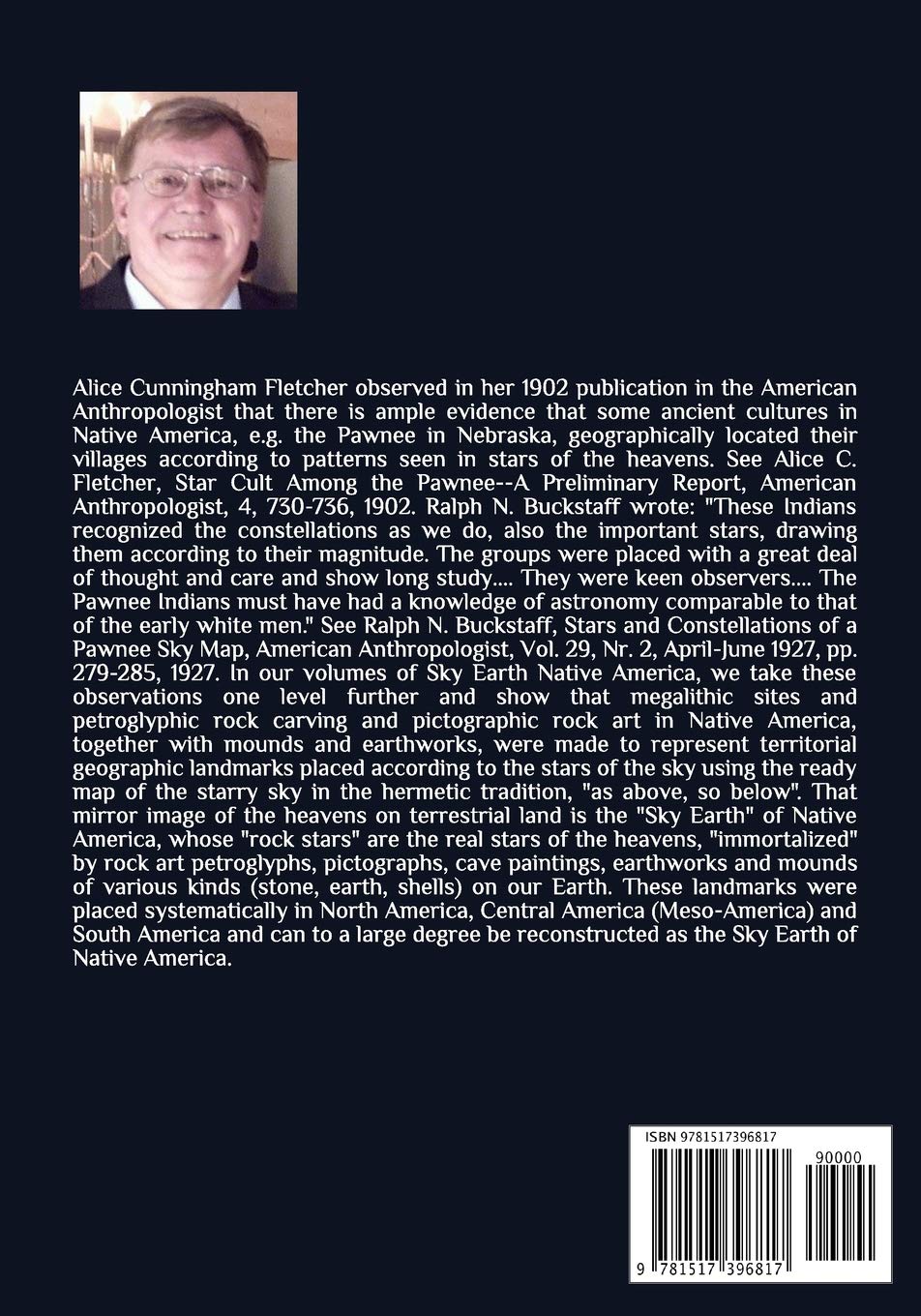
Sky Earth Native America -- in Two Volumes
Native American Rock Art Petroglyphs Pictographs
Cave Paintings Earthworks & Mounds
Deciphered as Land Survey & Astronomy by Andis Kaulins

paperbacks in color print
Volume 1, 2nd Edition, 266 pages

ISBN: 1517396816 / 9781517396817
Volume 2, 2nd Edition, 262 pages
ISBN: 1517396832 / 9781517396831

Sky Earth Native America Volume 1-----------Sky Earth Native America Volume 2
by Andis Kaulins J.D. Stanford                                         
by Andis Kaulins J.D. Stanford
(front cover(s))  
 
  ------

(back cover with a photograph of the author and book absract text)